BIOGRAPHY & MISSION
A life surrendered to Lord Krishna's service — from the temple corridors of Chennai to the sacred halls of ISKCON Mysore, tracing the extraordinary journey of a soul devoted to spreading the light of Bhagavad Gita and the eternal science of Krishna Consciousness.
The Life Story
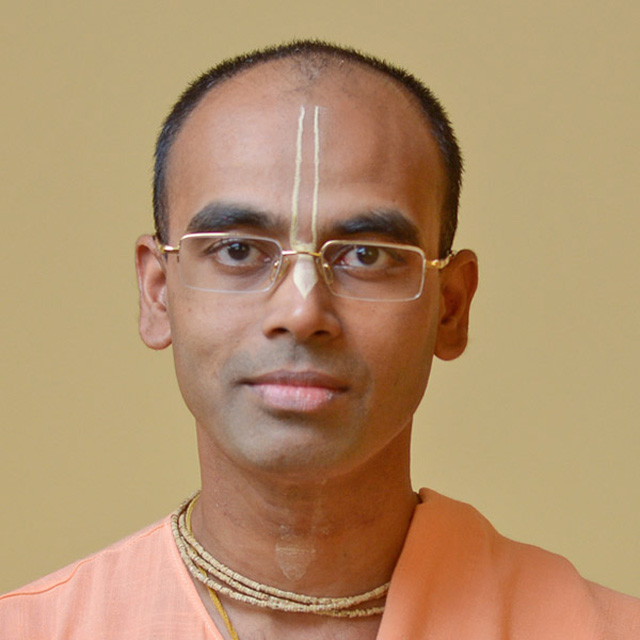
Sri Karunya Sagar Dasa was born in Chennai, Tamil Nadu, in 1977 — a city whose very air is perfumed with the fragrance of temple incense and whose streets echo with the devotional hymns of the Alvars, the great Vaishnava saint-poets who composed the Divya Prabandham over a thousand years ago. Chennai, known historically as Madras, has been a cradle of Vaishnavism since the time of Sri Ramanujacharya, the great 11th-century philosopher who systematized the devotional approach to God-realization known as Vishishtadvaita Vedanta.
Growing up in this spiritually charged environment, young Karunya was naturally drawn to the devotional practices that formed the fabric of South Indian life — the early morning suprabhatam (devotional wake-up songs) broadcast from temple loudspeakers, the grand chariot festivals (Brahmotsavam) that transformed entire neighborhoods into celebrations of divine glory, and the sacred tradition of temple worship that has remained unbroken for centuries. These early impressions would later prove to be the divine seed that would blossom into a life of complete spiritual surrender.
As a student, he demonstrated exceptional academic aptitude, particularly in mathematics and the sciences, which ultimately led him to pursue Civil Engineering — a discipline that, ironically, would train the very analytical faculties that would later help him appreciate the architectural magnificence of Vedic philosophy and the structural precision of Lord Krishna's cosmic design.
The pivotal chapter of Sri Karunya Sagar Dasa's life began when he enrolled in Civil Engineering at the prestigious M.S. Ramaiah Institute of Technology in Bengaluru. Bengaluru in the mid-1990s was a city of remarkable contrasts — a burgeoning IT hub where Silicon Valley aspirations collided with ancient wisdom traditions. It was in this unique confluence of modernity and tradition that providence arranged the most significant encounter of his life.
ISKCON Bangalore, established in 1987 under the visionary leadership of Madhu Pandit Dasa, had already become one of the most dynamic spiritual centers in India. The temple's outreach programs regularly visited colleges and universities across the city, distributing Srila Prabhupada's books — the same books that had already transformed millions of lives across 150 countries and had been translated into over 80 languages. When these books reached the young engineering student, they triggered a spiritual revolution within his consciousness.
"Bhagavad Gita As It Is" — Srila Prabhupada's masterful translation and commentary on the 700-verse dialogue between Lord Krishna and His devotee Arjuna — struck him with the force of divine revelation. Here was a text that addressed, with surgical precision, every fundamental question that had ever stirred within the human heart: Who am I? Why do I suffer? What is the purpose of existence? Is there life beyond death? What is my relationship with God? The answers, presented with flawless logic and supported by millennia of philosophical tradition, were irresistible to his truth-seeking intellect.
In 1996, at the age of 19, Sri Karunya Sagar Dasa made the most consequential decision of his life — he joined ISKCON Bangalore as a full-time brahmachari missionary, choosing the path of complete dedication to Lord Krishna's service over the lucrative career that his engineering degree would have afforded him. This was not the impulsive act of a naive youth but the deeply considered response of a soul that had found its true calling after years of searching.
As a new brahmachari, he underwent rigorous spiritual training that encompassed every dimension of Vaishnava life and practice. He rose before 4:00 AM daily for Mangala Arati (the first morning worship ceremony), chanted sixteen rounds of the Hare Krishna Maha-Mantra on his japa beads (approximately 1,728 individual mantras taking nearly two hours), studied Srila Prabhupada's books systematically, and engaged in various forms of devotional service — from cooking offerings for the temple deities to conducting street preaching (Hari Nama Sankirtan) in the bustling markets and neighborhoods of Bengaluru.
His dedication, intellectual depth, and natural leadership abilities were quickly recognized by senior devotees. He was entrusted with increasingly significant responsibilities, from leading preaching teams to organizing major festivals that attracted tens of thousands of participants. His ability to articulate complex philosophical concepts in accessible, relatable language made him an exceptionally effective preacher who could connect equally well with university professors, corporate executives, housewives, and street vendors.
Subsequently, he was transferred to ISKCON Mysore, where he served in various capacities before being elevated to the position of Vice President — a role that carries the immense responsibility of overseeing all spiritual programs, administrative functions, outreach initiatives, and developmental projects of one of Karnataka's most important ISKCON centers. Under his stewardship, ISKCON Mysore has flourished as a vibrant center of spiritual culture, education, and compassionate service, attracting devotees and visitors from across India and the world.
Guiding Principles
To systematically propagate the teachings of the Bhagavad Gita and Srimad Bhagavatam, as presented by His Divine Grace A.C. Bhaktivedanta Swami Prabhupada, to every individual in Mysore, Karnataka, and beyond — creating an enlightened society grounded in the principles of dharma (righteousness), satya (truthfulness), daya (compassion), and tapas (austerity). Through temple-based programs, educational outreach, cultural festivals, and humanitarian services, the mission aims to demonstrate that spiritual practice is not separate from daily life but is the very foundation upon which a truly progressive, harmonious, and peaceful civilization must be built.
To establish ISKCON Mysore as a world-class center for Vedic education, spiritual practice, and cultural preservation — a place where seekers from every background, nationality, and walk of life can discover the timeless wisdom of India's spiritual heritage and experience the transformative power of Bhakti Yoga. The long-term vision encompasses the development of a comprehensive spiritual campus featuring a magnificent temple, a Vedic educational institute, a research center for the study of ancient Indian sciences, and a model community that demonstrates the practical application of Bhagavad Gita's teachings in every aspect of human life — governance, economics, education, healthcare, agriculture, and interpersonal relationships.
Core Philosophy
The most fundamental teaching is the distinction between the temporary material body and the eternal spiritual soul (atma). As Lord Krishna declares in the Bhagavad Gita (2.20): "For the soul there is neither birth nor death at any time. He has not come into being, does not come into being, and will not come into being. He is unborn, eternal, ever-existing, and primeval. He is not slain when the body is slain." This understanding forms the bedrock of all spiritual practice and liberates the practitioner from the paralyzing fear of death and the debilitating attachment to temporary material identifications.
Among all paths of yoga described in the Vedic literature — Karma Yoga (the path of selfless action), Jnana Yoga (the path of philosophical knowledge), Dhyana Yoga (the path of meditation), and Ashtanga Yoga (the eightfold yogic system) — Bhakti Yoga, the path of loving devotional service to the Supreme Personality of Godhead, is declared by Lord Krishna Himself as the highest and most direct process of self-realization. "Always think of Me, become My devotee, worship Me, and offer your homage unto Me. Thus you will come to Me without fail." (Bhagavad Gita 18.65). Bhakti is not mere sentiment but a comprehensive science of consciousness transformation that engages every faculty of the human personality in the service of the Supreme.
The chanting of the Hare Krishna Maha-Mantra — Hare Krishna Hare Krishna Krishna Krishna Hare Hare, Hare Rama Hare Rama Rama Rama Hare Hare — is the yuga-dharma, the prescribed spiritual practice for the current age of Kali. Lord Chaitanya Mahaprabhu, the combined form of Radha and Krishna, declared that the holy name alone can deliver complete spiritual perfection. This is not a sectarian proposition but a universal spiritual principle endorsed by scriptures across traditions.
The Vedic scriptures — Bhagavad Gita, Srimad Bhagavatam, Upanishads, Brahma Sutra, and the writings of the Six Goswamis of Vrindavan — serve as the infallible authority for spiritual knowledge. Just as one cannot know the identity of one's father simply by speculation but must hear from the mother, similarly, the supreme truths about God, the soul, and the creation can only be understood through the descending process of revealed knowledge (avaroha-pantha) as transmitted through the disciplic succession (guru-parampara).
The relationship between a bonafide spiritual master (guru) and a sincere disciple is the cornerstone of Vedic spiritual education. "Just try to learn the truth by approaching a spiritual master. Inquire from him submissively and render service unto him. The self-realized souls can impart knowledge unto you because they have seen the truth." (Bhagavad Gita 4.34). Srila Prabhupada, as the transparent via medium of the disciplic succession originating from Lord Krishna Himself, continues to guide millions through his books, recorded lectures, and the institution he founded.
A true devotee of Krishna sees every living entity — regardless of species, race, gender, caste, or nationality — as an eternal spirit soul, a beloved child of God. This vision of universal brotherhood (vasudhaiva kutumbakam) naturally results in compassion, non-violence, and a desire to serve all beings. ISKCON's humanitarian programs, from food distribution to educational initiatives, are practical expressions of this philosophical principle that recognizes the spiritual equality of all souls.
Sacred Verses
ॐ
"Sarva-dharmān parityajya mām ekaṁ śaraṇaṁ vraja
ahaṁ tvāṁ sarva-pāpebhyo mokṣayiṣyāmi mā śucaḥ"
Abandon all varieties of religion and just surrender unto Me. I shall deliver you from all sinful reactions. Do not fear. — Bhagavad Gita 18.66
ॐ
"Man-manā bhava mad-bhakto mad-yājī māṁ namaskuru
mām evaiṣyasi satyaṁ te pratijāne priyo 'si me"
Always think of Me, become My devotee, worship Me and offer your homage unto Me. Thus you will come to Me without fail. — Bhagavad Gita 18.65
ॐ
"Harer nāma harer nāma harer nāmaiva kevalam
kalau nāsty eva nāsty eva nāsty eva gatir anyathā"
In this age of Kali, there is no other means, no other means, no other means for self-realization than chanting the holy name. — Brhan-Naradiya Purana
ॐ
"Patraṁ puṣpaṁ phalaṁ toyaṁ yo me bhaktyā prayacchati
tad ahaṁ bhakty-upahṛtam aśnāmi prayatātmanaḥ"
If one offers Me with love and devotion a leaf, a flower, a fruit, or water, I will accept it. — Bhagavad Gita 9.26